
What Are Keywords in SEO and Why Do They Matter?
When someone searches for a service, guide, or answer online, they use words that signal what they want. What are keywords in SEO? In simple terms, they are the words and phrases people type into search engines, and they help connect the right page to the right search.
On a practical level, keywords give your content direction. They help shape page titles, headings, service pages, blog topics, and internal links. On a wider level, they support how search engines understand what your page is about and whether it matches the searcher’s intent.
We often see businesses create content around what they call a service internally rather than the language their audience actually uses. That gap can weaken visibility, even when the service itself is strong. This guide gives you a clear overview of how keywords fit into modern SEO, and if you want broader context around the subject, you can also read our guide to SEO.
Key Takeaways
Keywords help connect the language people use in search with the pages that best answer what they need.
Good keyword use is about clarity and relevance, not repeating the same phrase throughout a page.
Search intent matters because the same topic can need a guide, service page, local page or product page depending on what the user wants.
Short-tail keywords can be competitive and broad, while long-tail keywords usually show clearer intent.
Keyword volume and difficulty are useful guides, but they should not be followed blindly without considering relevance and page purpose.
Keyword research helps shape service pages, blog topics, internal links and the overall structure of a website.
What Are Keywords in SEO?
A simple definition of a keyword
If you have ever wondered what is a keyword, the simplest answer is this: it is a word or phrase someone uses when searching online. That might be something broad like “web design” or something more specific like “WordPress web designer in Bristol”.
In SEO, a keyword is not limited to one single word. It can be a short phrase, a question, or a longer search query. The term has stayed around because it is a useful shorthand, even though real searches are often more natural and more detailed than they used to be.
That matters because your pages need a clear theme. If your homepage, service page, or blog post tries to cover too many unrelated phrases at once, the message becomes vague. A focused page is easier for both search engines and real people to understand.
Why keywords help search engines understand a page
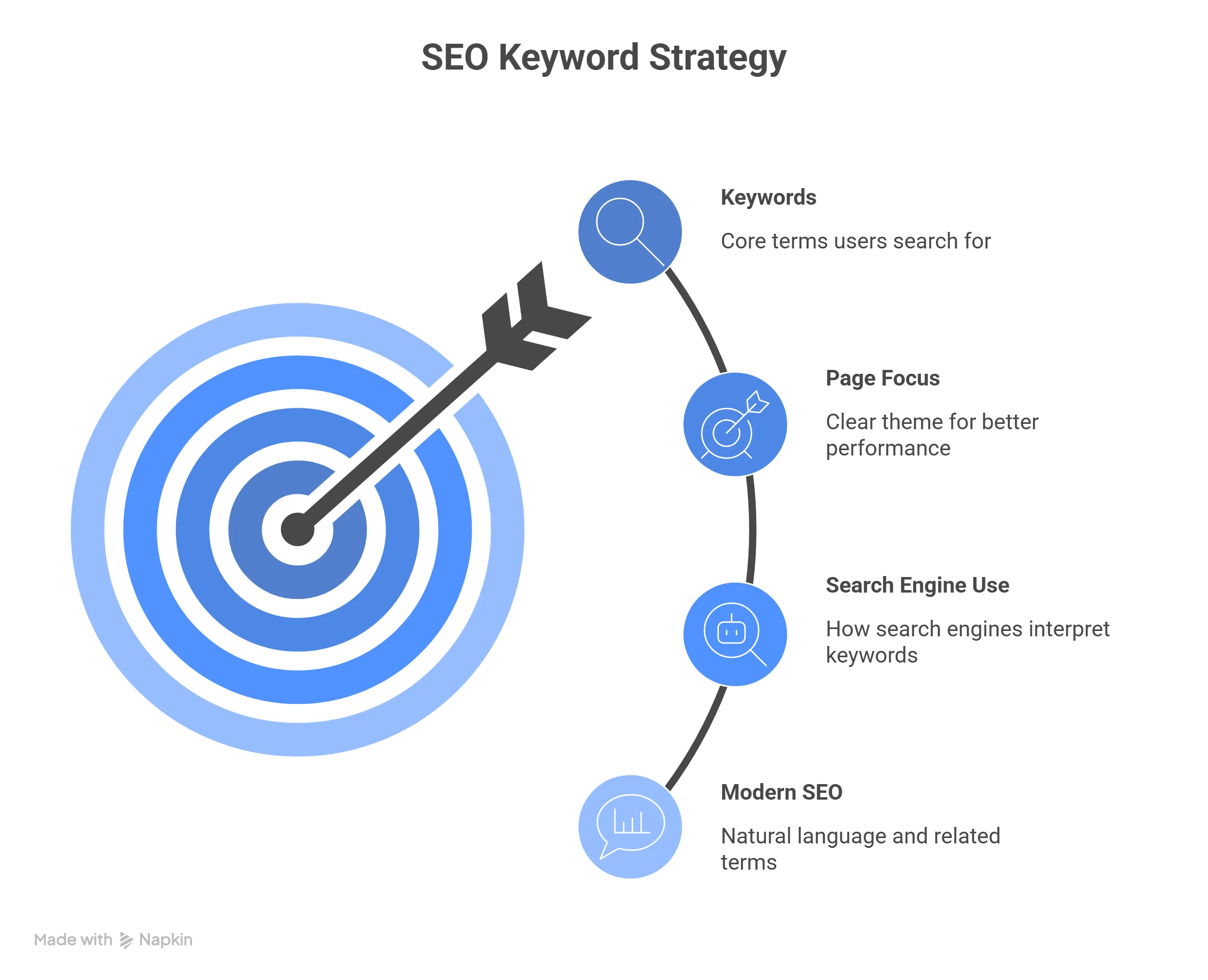
Search engines do not read a page the way a human does, but they do look for signals that explain what the page covers. Titles, headings, body copy, image context, internal links, and the overall topic all help build that picture.
Google’s own SEO Starter Guide explains that repeating the same words excessively is tiring for users and counts as keyword stuffing. That is a useful reminder that keywords are not magic ranking buttons. Their job is to clarify relevance, not to be forced into every line.
This is where the idea of keywords becomes more than a simple definition. They are really a way of describing page focus. If a page is clearly about one subject and uses the language people expect to see around that subject, it becomes easier for Google to match it with the right search.
Why keywords still matter in modern SEO
Some people talk about keywords as if they no longer matter because search engines are smarter now. That misses the point. Search engines are better at understanding meaning, but they still need clear signals about what a page covers.
Keywords still matter because they help shape relevance. They support titles, headings, page themes, and the overall relationship between one page and another.
So, what are keywords in modern SEO if they are not just old-school ranking signals? They are still one of the clearest ways to connect a topic with the language people actually use when searching.
Keywords are not just exact-match phrases
Modern SEO is not about taking one phrase and pasting it into a page ten times. Search Engine Land’s guide to on-page SEO explains that search engines understand semantic relationships between words, which is why strong content can cover a topic naturally around the main keyword rather than repeating one phrase over and over.
For example, a page targeting a web design service might also mention website builds, WordPress development, user experience, page speed, and mobile layouts. Those terms support the topic and make the page more complete.
That is why the best keyword use tends to feel invisible. The page reads naturally, answers the searcher’s question, and still gives search engines enough context to understand what it is about.
Why are keywords important for SEO?
How keywords connect your content to search intent
A keyword is only useful when it matches what the searcher wants. This is where keyword intent matters. Search intent simply means the reason behind a search.
Keywords help you spot that difference. Once you understand intent, it becomes easier to see what type of page belongs to the search.
Informational intent
This is when someone wants to learn something. A search like “what is SEO” shows that the person is looking for an explanation, not a service provider.
Navigational intent
This is when someone wants to reach a specific brand, website, or page. A search such as “SEMrush login” or “Google Search Console” usually means the searcher already knows where they want to go.
Commercial intent
This is when someone is comparing options before making a decision. A phrase such as “best SEO agency for small business” suggests they are researching providers, services, or products.
Transactional intent
This is when someone is close to taking action. A search like “hire SEO consultant Bristol” or “buy WordPress hosting” shows stronger intent to enquire, book, or purchase.
Local intent
This is when the search includes a place name or shows a clear need for something nearby. Searches such as “web designer in Bristol” or “accountant near me” often need a local service page or location-based result.
Why the right keywords can improve visibility
Good keyword targeting does not guarantee rankings, but it gives your content a better chance of appearing for the right searches. When the language on the page lines up with the language your audience uses, relevance improves. To go deeper, read our comprehensive step-by-step blog about how to conduct keyword research for SEO.
This matters especially for small businesses. If your website describes a service in one way but your customers search for it in another, visibility can suffer even when the offer itself is strong.
For example, a business might write “digital growth solutions” on a service page when potential customers are really searching for “SEO services”. A therapist might talk about “emotional wellbeing support” when people are searching for “CBT for anxiety”. A web designer might describe “bespoke digital experiences” when the audience is actually typing “WordPress web design”.
For service businesses, this often shows up on service pages, local landing pages, and blog content where the wording needs to match real search behaviour rather than internal business language.
What is keyword stuffing in SEO, and why does it matter?
A common misunderstanding is that SEO improves when you keep adding the same phrase throughout a page. In reality, overuse usually makes the copy awkward and less helpful.
This is where keyword stuffing in seo becomes relevant. Keyword stuffing means repeating words and phrases so often that the page starts to feel forced rather than useful. You might see it in headings, body copy, or internal links where the same wording appears again and again without adding any real value.
Search engines want to show pages that satisfy the user. That means page structure, topical relevance, clarity, helpful detail, and a good experience matter alongside keyword use. A page that reads naturally and answers the search well is far more useful than one written around a formula.
So while keywords matter, they only work properly when they support the page rather than dominate it.
Different types of keywords in SEO
Short-tail keywords
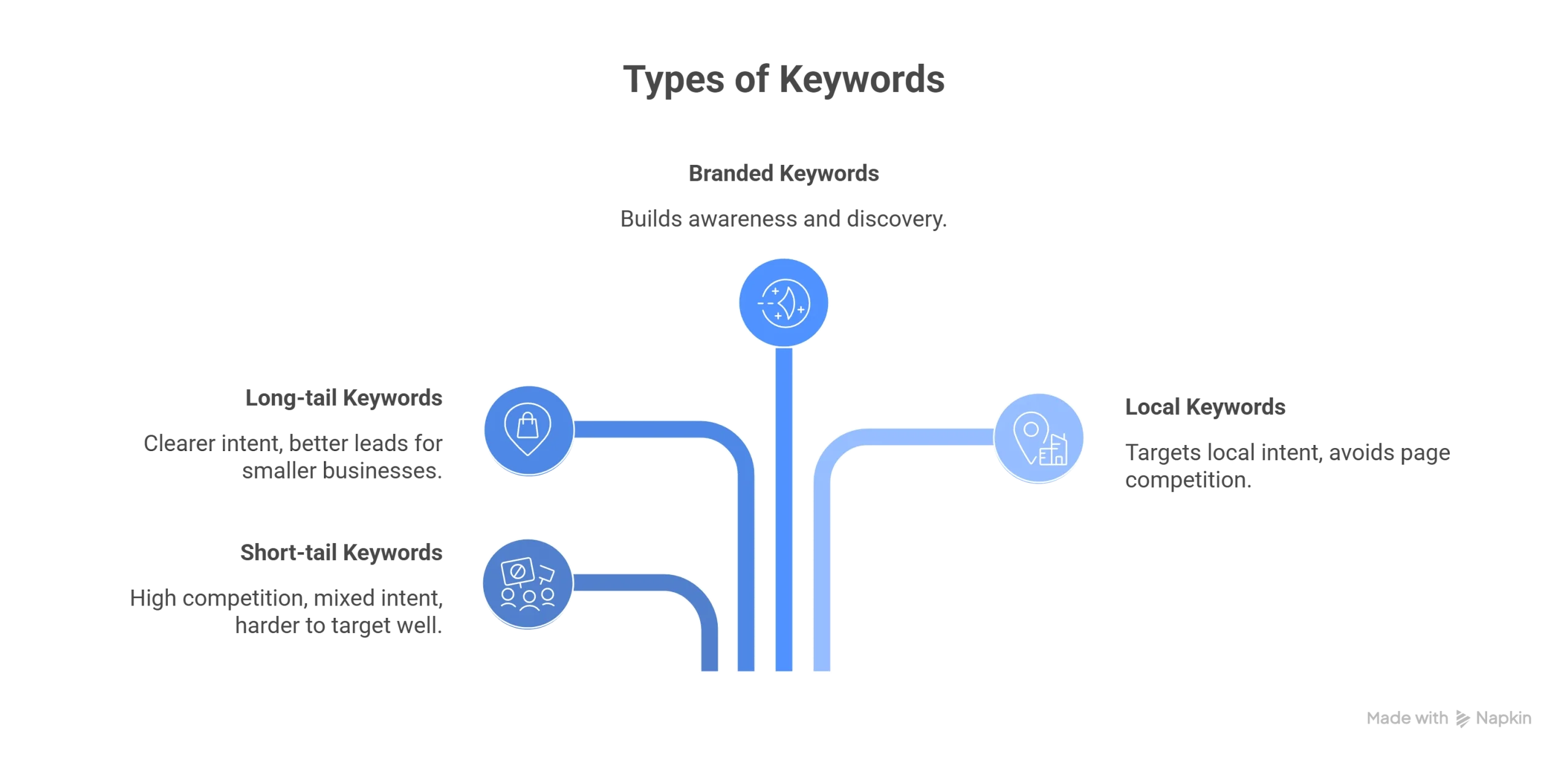
You will often hear people talk about short tail and long tail keywords. Short-tail keywords are broad phrases such as “SEO agency” or “web design”. They can attract a lot of attention, but they are also more competitive and often less specific.
Because they are broad, short-tail keywords can cover a wide mix of user intent. That can make them harder to target well, especially for smaller businesses trying to reach a defined audience.
Long-tail keywords
Long-tail keywords are more detailed, such as “SEO agency for accountants” or “web designer for therapists in Bristol”. These phrases tend to reveal clearer intent because the searcher is being more specific about what they need.
For smaller businesses, long-tail phrases can be especially useful because they often connect with a narrower, better-qualified audience. They may bring in fewer visits on paper, but the relevance can be much stronger.
Branded keywords and non-branded searches
Another useful distinction is between branded keywords and non-branded keywords. A branded search includes a company, service, or product name, such as “Vamos Web Design SEO guide”. A non-branded search does not, such as “SEO guide for small businesses”.
Branded searches are valuable because they show awareness and recognition. Non-branded searches matter because they help you reach people who do not know your brand yet.
A healthy SEO strategy usually needs both. One supports existing demand, while the other helps new people discover you.
Local keywords for service businesses
If you run a service business, local keywords deserve special attention. These are phrases tied to a place, such as “accountant in Leeds” or “SEO consultant Bristol”.
They matter because local intent changes the type of page that makes sense. A broad service page and a location-focused service page may both be useful, but they should not compete for the exact same purpose.
For many UK businesses, local keywords are part of how a site earns relevance in a specific area rather than trying to look equally relevant everywhere.
That same principle shapes my SEO service in Bristol, where keyword targeting needs to reflect both what the business offers and how people actually search for it locally.
What do keyword volume and keyword difficulty mean?
What keyword volume tells you
The phrase keyword volume, also known as ‘search volume’, refers to estimated search demand. In plain English, it helps you understand roughly how often a term is searched over time**.**
Google Ads explains that average monthly searches show estimates for how many searches a keyword gets each month. That makes volume useful for spotting demand, but it is still only one part of the picture.
Volume can help you spot demand, compare topics, and understand whether people are actively searching for a phrase. On its own, though, it does not tell you whether a keyword is the best fit for your page.
What is keyword difficulty in SEO?
So, what is keyword difficulty? It is a score used by SEO tools to estimate how hard it may be to rank for a term in organic search.
Different tools calculate this in different ways, which is why the number should be treated as guidance rather than a fixed truth. Some tools lean heavily on factors such as authority, relevance, and the signals covered in our guide to backlinks in SEO, while others factor in the strength of pages already ranking.
That means keyword difficulty is helpful for comparison, but not something to follow blindly. It gives you a clue about the challenge, not a final answer.
Why high-volume keywords are not always the best target
High search volume can look exciting, especially when you are planning new content. But broad, high-volume terms are often the hardest to compete for, and they may not reflect the exact audience you want.
Another point that gets mixed up is the difference between SEO difficulty and paid search competition. Google Ads says that its Keyword Planner competition column reflects advertiser competition, not an organic SEO ranking score. That distinction matters when you are reading keyword tools.
In many cases, a lower-volume phrase with clearer intent is more useful than a bigger term that is vague or overly broad.
What is keyword research in SEO?
The importance of keyword research before creating content
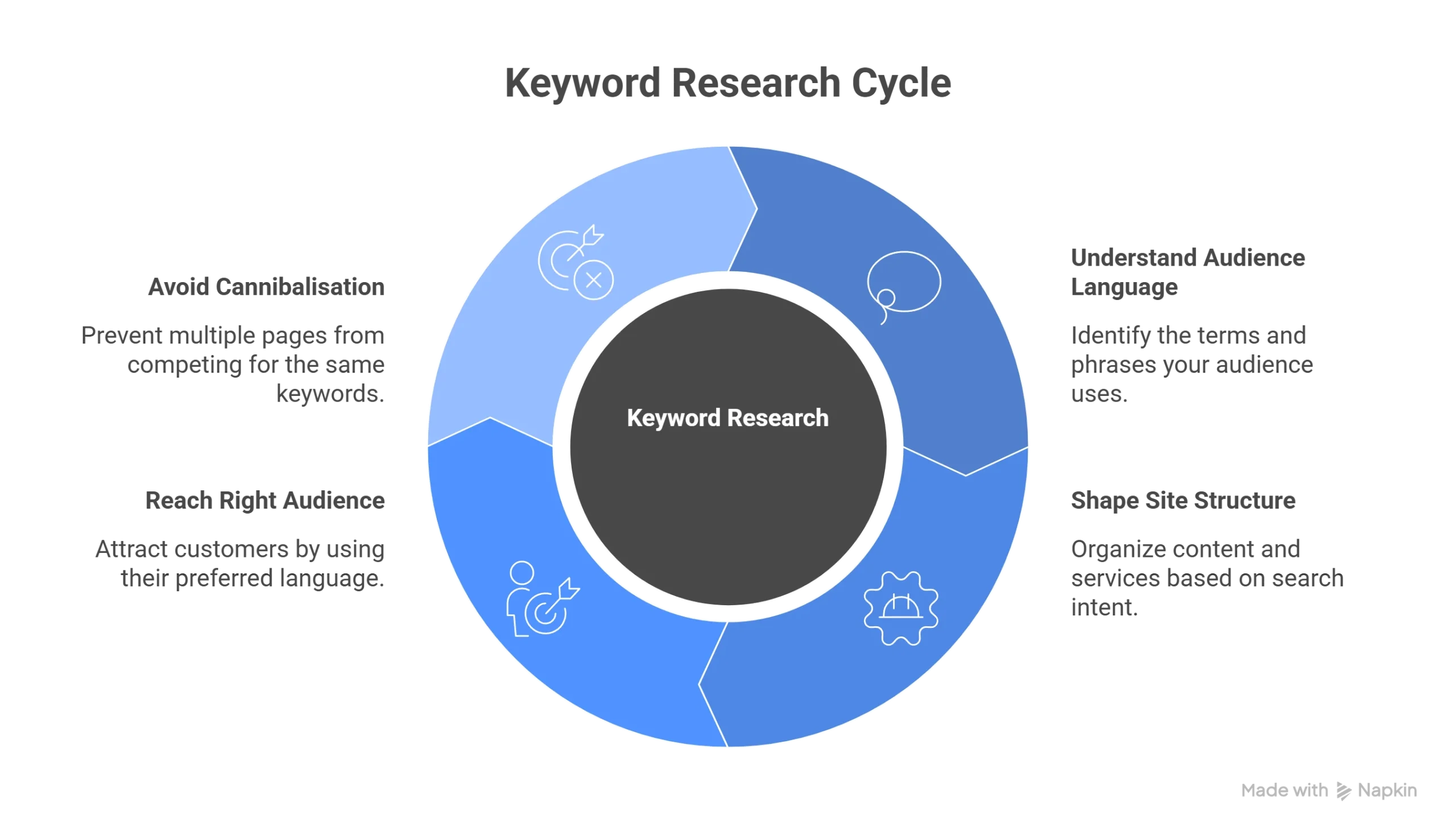
If you are asking what is keyword research in SEO, the simplest answer is that it is the process of understanding the language, topics, and intent your audience uses before you publish or optimise a page.
This article is not about how to carry out that process step by step, but the importance of keyword research is still worth understanding. It helps you avoid guessing. It also helps you shape content around what your audience is genuinely looking for rather than what sounds right internally.
How keyword research supports SEO planning
Keyword research influences more than blog ideas. It can shape how a website is organised.
It helps clarify which services deserve their own pages, how supporting content should be grouped, and whether page labels reflect the words real people use. That is one of the reasons keyword work sits closely alongside SEO, web design, and web development.
When businesses skip this stage, websites often become harder to navigate and harder for search engines to interpret clearly.
Why good research helps you target the right audience
Businesses often describe their services in expert or internal language, while customers search more simply.
That is where keyword research becomes useful. It helps you understand the wording your audience is actually using, which makes it easier to write pages that feel clearer, more relevant, and more closely matched to their expectations.
Keyword cannibalisation and page overlap
Keyword cannibalisation happens when multiple pages on the same site chase the same intent too closely. This can confuse search engines because the site is sending mixed signals about which page should be the main answer.
In many cases, the issue is less about the keyword itself and more about page planning. If two service pages, two blog posts, or a service page and a guide all target the same purpose, they can compete with each other instead of strengthening the site.
That is why keyword clarity matters at the site level, not just the page level.
Case Study
The problem the client had when they first contacted Vamos Web Design
One anonymised service business came to us with a website that looked polished on the surface, but the content lacked focus. The service pages used broad marketing language, several pages overlapped, and the headings were written more for style than clarity.
As a result, the site struggled to communicate a clear theme to search engines. It also made the user journey less direct because visitors had to work harder to understand which page covered which service.
The method that was used
We reviewed the site page by page and looked at how each core service was being described. Instead of forcing more phrases into the copy, the focus was on clarity.
Some pages were narrowed around a stronger central theme. Some headings were rewritten in plainer language. Some overlapping content was combined or separated so each page had a clearer role. Internal links were also improved so the relationship between core pages and supporting pages was easier to follow.
The goal was not to chase every possible variation. It was to make the site easier to understand and easier to trust.
The successful results
Over time, the site became easier to interpret for both search engines and users. The pages had clearer themes, the internal linking made more sense, and the content matched customer language more closely.
That led to better-qualified traffic, fewer mixed messages across similar pages, and a stronger foundation for future SEO work. In practical terms, the website stopped trying to say everything at once and started saying the right thing on the right page.
Final thoughts
Keywords still matter because they help connect language, intent, and page purpose. They are not about stuffing copy or chasing volume for the sake of it. So, what are keywords really doing in SEO today? They help search engines understand what a page covers and help businesses speak in the same language as their audience. In the end, SEO works best when you use the words your audience uses on the pages that best answer what they need.


FAQs
01
Are keywords still important for SEO in 2026?
Yes, but not in the old sense of repeating one phrase over and over. They still help search engines understand page focus and help businesses align content with what people are searching for.
02
What is the difference between a keyword and a search query?
A keyword is the term marketers or SEO professionals use to describe a target phrase or topic. A search query is the actual wording someone types into Google, which is often more specific or conversational.
03
Can a page rank without using the exact keyword repeatedly?
Yes. Search engines can understand related language, page context, and topic depth. A page still needs clear relevance, but that does not mean forcing the same exact phrase into every section.
04
What is the difference between short-tail and long-tail keywords?
Short-tail keywords are broader and usually more competitive, while long-tail keywords are more specific and often show clearer intent. Smaller businesses often benefit from long-tail phrases because they can align more closely with real customer needs.
05
Do keywords help with local SEO?
Yes. Local keywords help signal where a service is relevant and who it is for. For service-based businesses, location-based searches can shape how service pages and local landing pages are structured.
Author Bio

Fred Morpeth
Table of Contents